Serving Edmonton for over 120 years

Emerald ash bore

Identification

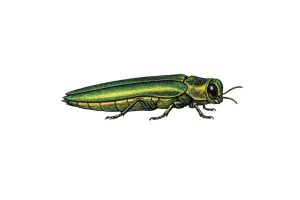
Size: 7.5–13.5 mm long
Color: Metallic emerald green with a coppery red or purple abdomen
Description: The Emerald Ash Borer is an invasive wood-boring beetle from Asia that attacks and kills all native ash tree species. It is considered one of the most destructive forest pests in North America and has been confirmed in Alberta since 2019.

The Emerald Ash Borer (Agrilus planipennis) is an invasive beetle native to Asia that has devastated ash tree populations across North America since its accidental introduction in the early 2000s. In Alberta, it was first confirmed in Edmonton in 2019 and is now considered one of the most serious threats to urban and rural ash trees in the province.

EAB targets all native and ornamental ash species (Fraxinus spp.), including green ash — the most widely planted boulevard tree in Alberta municipalities. Adult beetles are rarely seen, spending most of their life cycle beneath bark. It is the larvae that cause tree death by feeding on the phloem and cambium, disrupting the tree’s ability to transport water and nutrients. Infested trees typically die within 3–5 years.

EAB spreads primarily through the movement of infested firewood. Never move firewood from an infested area. In many Alberta municipalities, the removal or treatment of infested ash trees is regulated — consult your municipality or a certified arborist before taking action.

Adults are bright metallic emerald green, roughly the size of a grain of rice (7.5–13.5 mm), with a distinctive coppery red or purple abdomen visible when wings are spread. They are active June through August but are rarely spotted due to their small size and time spent under bark.

More reliable identification signs include:

  • D-shaped exit holes (approximately 3–4 mm wide) in the bark of ash trees
  • Serpentine (S-shaped) feeding galleries are visible when the bark is peeled back, packed with fine sawdust-like frass
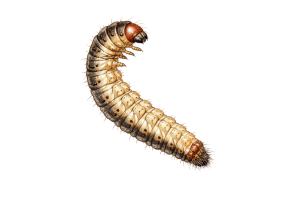
  • Cream-coloured, flat-headed, S-shaped larvae found beneath the bark
  • Increased woodpecker activity — woodpeckers actively feed on EAB larvae and may strip large sections of bark

  • Dieback starting in the upper canopy and progressing downward
  • D-shaped exit holes (3–4 mm) scattered across branches and trunk
  • Serpentine galleries beneath the bark when peeled back
  • Epicormic sprouting — shoots growing directly from the trunk or main branches
  • Bark splitting or cracking, sometimes revealing galleries below
  • Yellowing leaves, early leaf drop, or sparse foliage in affected sections
  • Heavy woodpecker activity and large patches of stripped bark
  • Do not move firewood — buy local firewood and burn it where you buy it
  • Inspect ash trees annually, especially in spring and early summer, for exit holes or canopy dieback
  • Report suspected EAB activity to Alberta Agriculture and Irrigation or your municipality immediately
  • Consider proactive insecticide trunk injection treatments for high-value ash trees — consult a certified arborist
  • In high-risk areas, discuss removal and replacement of ash trees with your municipality before infestation occurs

BIRCH FUMIGATORS

est. 1900

Don't Let Bugs Get the Best of You

BIRCH FUMIGATORS

est. 1900

Don't Let Bugs Get the Best of You